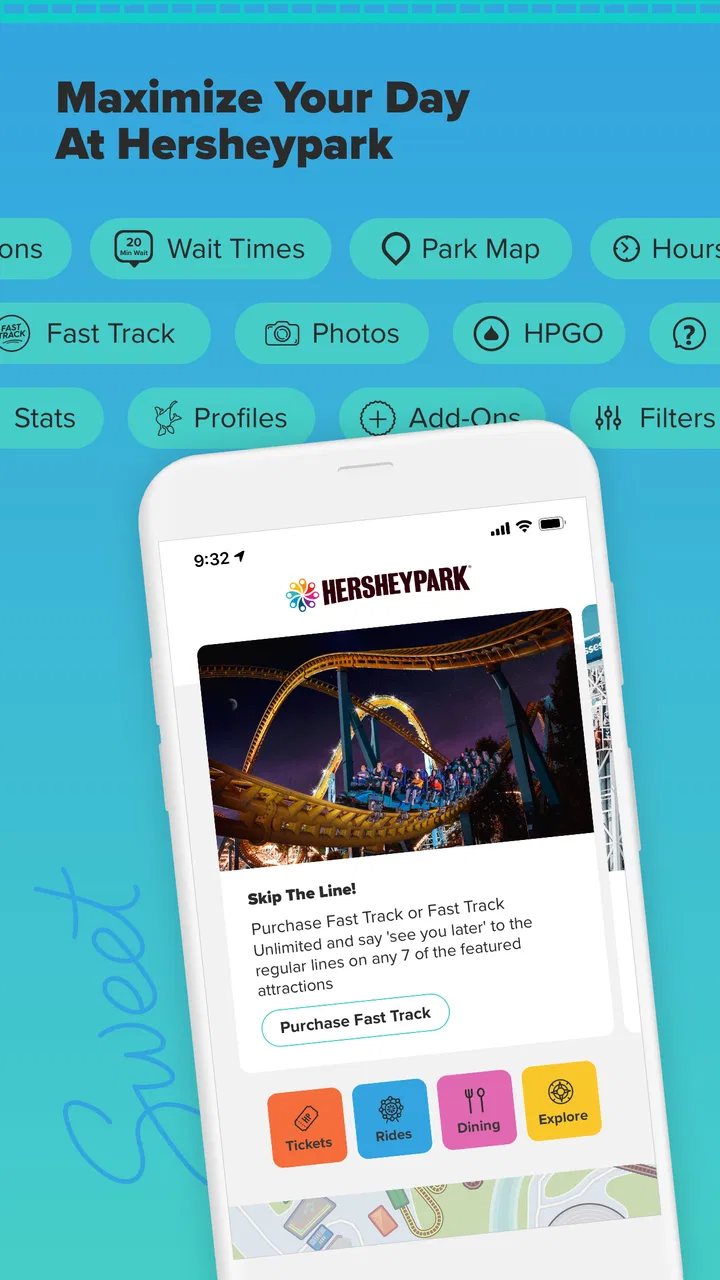
Hersheypark
- 4.7
- Rating
- 500.00K
- Installs
- Free
- Price

 Analysis by App-foxy
If I were planning a day at Hersheypark, I would install Hersheypark before leaving home rather than treating it as something to open only after arriving. This free Travel & Local app from Hershey Entertainment and Resorts Company is designed around the practical side of visiting the park: getting oriented, deciding what to do next, and reducing the amount of time spent searching for information on a busy day. It is not an entertainment app that replaces the visit. Its value comes from helping the visit feel less scattered.
That distinction matters. A theme-park companion has a very different job from a general maps app or a browser search. A normal map can help you reach the destination, but it usually does not give you the same place-focused context once you are inside. On the other hand, a park app can feel unnecessary if you prefer wandering without a plan. After using this one as a visitor would, I see it as most useful for families, first-time guests, and anyone trying to fit several priorities into one day without repeatedly stopping to ask where to go.
What the app is like to use during a real park day
I find trust in a park companion starts with knowing what role it is meant to play: Hersheypark is a free, official Travel & Local app from Hershey Entertainment and Resorts Company, focused on one destination rather than a general travel service. Before depending on it during a visit, I would consider the choices the app makes visible and how much personal information I am comfortable sharing. That leads naturally to the practical question of which controls a visitor can actually check.
You May Also Like

 Blood Strike: 2.5 Anniversary
Blood Strike’s Loadouts Turn Every Drop Into a Tactical Gamble
A close look at Blood Strike’s custom loadouts: how fast access to signature weapons reshapes its battle royale rhythm, rewards preparation, and narrows the gap between fights.

 Pandora - Music & Podcasts
Pandora’s Music Is Easy to Start, but Harder to Recover
Pandora’s strength is its low-effort path from a seed to a station. Its weak spot is how much confidence it asks you to place in connection, setup, and quiet recovery.

 8 Ball Pool
 Is Built on Rivalries, Rematches, and Routine
A close look at the rivalries, rematches, shared routines, and unanswered safety questions that turn a quick pool match into a persistent mobile community.

 Samsung Music
’s Quiet Strength Is Playing What You Already Own
Its reach comes less from spectacle than from dependable access to a personal library. That simplicity is both the app’s strongest retention engine and its ceiling.

 AccuWeather: Weather Radar
AccuWeather Review: A Quick, Clear Forecast for Everyday Decisions
For everyday plans, the best forecast is the one you can understand quickly. AccuWeather makes rain timing, radar, and local conditions easy to act on, with a few trade-offs.

 Hill Climb Racing
Why Hill Climb Racing Still Turns Crashes Into One More Run
A tiny car, a bumpy hill and one more upgrade: Hill Climb Racing keeps resurfacing because its simple chaos makes every near-miss feel personal.
More From Our News Desk



A quick start is more important than flashy presentation
The first thing I look for in a park app is whether it helps me make a decision quickly. At Hersheypark, the useful question is rarely “what information exists?” It is more often “what should I do next?” A good companion should shorten the path from opening the phone to choosing a ride, attraction, or area. That is where this app makes sense: it puts the park experience in one dedicated place instead of making me jump between a browser, a map app, and saved notes.
Its store summary presents it as the official app for Hersheypark, and that official focus is important. I would not expect the same kind of context from a generic local guide. The app is built for the park rather than for tourism in the surrounding area, so I would use it for on-site decisions and pair it with a regular navigation app for the journey to the destination. That division of labor keeps expectations realistic and avoids forcing one tool to do everything.
In everyday use, the biggest speed advantage is not necessarily that every screen feels instant. It is that the app can reduce mental switching. If I am with children, carrying bags, and trying to keep a group together, opening a dedicated park guide is easier than composing several searches. If I am visiting alone and already know the layout, the benefit is smaller. The app earns its place when the park itself creates enough choices that memory and casual browsing stop being efficient.
Planning before arrival saves more time than planning every minute
I would use the app at home for a short orientation session, not for building an over-detailed timetable. Theme-park conditions change as the day develops, and a rigid schedule can become frustrating after one delayed decision or an unexpected change in the group. A better workflow is to identify a few priorities, learn where they sit relative to one another, and leave room for adjustments.
One useful habit is to divide the visit into broad zones or phases. I might decide which attractions matter most early in the day, where I want a slower break, and which choices can wait until later. The app is more valuable when it supports that kind of flexible plan than when I treat it like a stopwatch. I can check the next destination, estimate the walking direction, and keep the group moving without constantly reopening a web search.
For families, I would also use the planning stage to discuss expectations before arriving. Children may focus on one attraction while adults are thinking about food, rest, or the easiest route between areas. Having the app ready gives everyone a common reference point. That sounds simple, but it can prevent the familiar situation where one person is trying to remember a location, another is checking a social post, and a third is asking staff for directions.
Heavy-use moments reveal whether a park app is genuinely useful
The most demanding moments are likely to be the ones when many visitors are making decisions at once: arriving, leaving a popular area, choosing the next attraction, or checking the phone repeatedly while walking. This is where I judge a park app differently from a normal utility. A quiet test at home tells me whether it opens, but a busy visit tells me whether its organization remains understandable when I am distracted.
During those moments, I would avoid repeatedly browsing every section. Instead, I would open the app with a specific question: where should we go next, what is nearby, or which part of the park fits our current energy level? That narrower workflow makes the experience feel faster because I am not asking the app to become a complete replacement for my own judgment. It also reduces the time the phone stays in my hand, which is useful when moving through crowded paths.
A less obvious advantage is that the app can help a group recover from a bad plan. Suppose a child is tired, a preferred attraction no longer fits the schedule, or the group has ended up farther away than expected. Rather than treating the original plan as failed, I can use the park guide to reorient and choose a nearby alternative. That recovery function is more valuable to me than a perfect morning itinerary, because real visits rarely follow one.
Stability matters more than visual polish when the phone is needed outdoors
I judge reliability here by whether the app remains practical across repeated short checks. A visitor may open it, lock the phone, walk for several minutes, and return to it later. That pattern is different from sitting at home and reading every screen in one session. The best experience is one where I can return without having to reconstruct my entire purpose each time.
The app has been available since May 27, 2011, and its current version is 3.1.44. Those details suggest a long-running product rather than a newly assembled companion, although longevity alone does not guarantee that every visit will feel perfect. What I appreciate about an established park app is the expectation that it has been shaped around recurring visitor needs. I would still keep a backup plan in mind, especially for important meeting points or arrangements that should not depend on one phone.
My practical reliability advice is simple: open the app before entering the busiest parts of the day, keep the phone charged, and do not wait until the entire group is standing still in a crowded walkway to begin exploring it. This is not a criticism unique to Hersheypark. Any location-based guide becomes harder to use when the user is rushed, the screen is hard to see, or the network experience is inconsistent. Preparation makes the app feel more dependable.
Phone resources and device limits deserve attention
Hersheypark is a visual, outdoor destination, so screen brightness, battery condition, and comfortable handling can affect the experience as much as the app itself. I would not expect a phone to spend the whole day with its display active. Instead, I would check the app in short bursts, lock the screen while walking, and carry a charging solution if the visit is long. This approach is especially sensible for families, because one device may also be used for photos, messages, tickets, or coordinating with people who have separated.
The listed minimum operating system is Android 8.0. That makes the app accessible to older compatible Android devices, but compatibility is not the same as speed. A newer phone may reopen screens more comfortably, while an older device with limited free storage or a tired battery may make every park app feel less pleasant. If your phone is already slow with ordinary maps and browsers, I would test this app at home before relying on it for the whole visit.
There is also a human constraint: looking at a phone too often can work against the reason for visiting. I would use the app as a short reference tool rather than keep it open continuously. A useful compromise is to decide on the next one or two actions, put the phone away, and check again only when the plan changes. That keeps the app helpful without allowing it to dominate the day.
Who gets the most value from it
I think this app is a strong fit for first-time Hersheypark visitors who do not yet understand how they want to move through the park. It is also useful for families with different interests, because a shared guide can make compromises easier. A group can compare options, choose a meeting area, and avoid relying on one person’s memory of the layout.
It may also suit visitors who like structure but dislike strict schedules. The app can support a loose plan: priorities first, flexible choices afterward, and regular reorientation when the group’s energy changes. That is the style I would recommend. It gives the visit enough direction to avoid waste while leaving space for discoveries and ordinary pauses.
I would be less enthusiastic for someone who already knows Hersheypark extremely well and prefers not to use a phone during a day out. A regular map app may be enough for reaching the area, and a fully offline personal plan may feel simpler for a visitor who has already memorized the park. The official app is also not a substitute for asking staff when a situation is urgent or unusually specific. Its role is guidance and planning, not personal assistance in every circumstance.
How it compares with the usual alternatives
The closest alternative is probably using a browser and a general map app. That combination is flexible, familiar, and useful before the trip, but it can become awkward once I am inside the park. Search results may mix official information with older pages, and a general map is not organized around the decisions a park visitor makes. The Hersheypark app has the advantage of keeping the visit centered on one destination.
Another alternative is relying on printed information or asking employees for directions. Printed material has the benefit of not using battery power, while staff can provide human context. However, paper is less convenient when plans change, and asking for every small decision becomes tiring for both the visitor and the group. I see the app as a middle option: more adaptable than paper, less personal than staff, and more focused than a general search.
There is also the option of using no guide at all. That can be enjoyable if the goal is spontaneity and the group is comfortable with uncertainty. I would choose that approach for a relaxed visit with no must-do list. For a short visit, a first visit, or a day with children who have specific priorities, I would rather have the app available even if I only open it occasionally.
Small workflows that make the experience better
My first practical tip is to prepare a short priority list before arrival, then use the app to understand how those priorities fit together instead of trying to schedule every minute. This reduces backtracking and makes it easier to change direction when the day does not unfold as expected.
My second tip is to use it at transition points. I would check it after finishing a major activity, before leaving a quieter area, and whenever the group’s energy changes. Those moments are more useful than constant checking because they turn the app into a decision aid rather than a distraction.
My third tip is to plan for recovery. Choose a general fallback area or a nearby alternative before the group becomes tired. If the original choice is no longer practical, you already have a direction to take. This is where a dedicated park guide can outperform scattered notes: it helps me rebuild the plan around the current location rather than start from zero.
Finally, I would make sure everyone knows who is carrying the main device and what the meeting approach is if the group separates. The app can support coordination, but it cannot remove the need for a clear human plan. That distinction is easy to overlook when a digital guide appears to put the whole visit in one place.
Value, audience, and the overall performance impression
The app is free and carries an Everyone content rating, which makes it an easy recommendation for households that want an official planning companion without adding a purchase decision. Its audience reach is substantial, with over 500 thousand installs, and its average rating is 4.6 from around 9 thousand ratings. I read that as a sign that the basic idea works for many visitors, while still leaving room for individual preferences about how much guidance a park day should involve.
In my experience, the perceived speed comes less from dramatic animation and more from having the right information in the right context. When I know what I am looking for, the app can make a busy visit feel more manageable. When I open it without a question and browse aimlessly, the benefit drops quickly. That is an important trade-off: it rewards purposeful use rather than passive scrolling.
For stability and resource demands, I would describe it as a practical companion that should be treated like any other outdoor navigation tool: keep the device charged, avoid unnecessary continuous screen use, and prepare before the busiest moments. Older compatible phones may not feel as comfortable as newer ones, but the minimum Android requirement of 8.0 keeps the entry point reasonably broad. The app’s value is strongest when it helps me recover from changes, not when I expect it to eliminate every inconvenience.
After using it as a visitor-focused guide, I would recommend Hersheypark to anyone making a first visit, bringing children, or trying to balance several attractions with limited time. I would skip it only if I wanted a completely phone-free day or already knew the park well enough that a dedicated guide would add clutter. For most other visitors, installing it before leaving home is a sensible, low-risk step. It will not plan the perfect day for me, but it can make the imperfect, changing version of a theme-park day easier to navigate.
FAQs for Hersheypark
01What is Hersheypark's main attraction?
Hersheypark offers a wide array of attractions, but its main highlight is the thrilling roller coasters. With over 15 coasters, including the exhilarating Candymonium and the iconic Comet, the park caters to adrenaline seekers of all ages. Additionally, the park features themed areas and a water park, offering a comprehensive entertainment experience.
02Are there any special features for families at Hersheypark?
Yes, Hersheypark is family-friendly and includes attractions suitable for all ages. There are kiddie rides, family rides, and interactive zones designed specifically for younger guests. The park also offers family-friendly dining options, stroller rentals, and nursing stations, ensuring a comfortable experience for families with children.
03What dining options are available at Hersheypark?
Hersheypark boasts a diverse range of dining options, from quick bites to sit-down restaurants. Visitors can enjoy classic amusement park fare like burgers and fries, as well as unique treats such as Hershey’s chocolate-themed desserts. There are also healthier options and accommodations for dietary restrictions, ensuring something for everyone.
04Is Hersheypark accessible for individuals with disabilities?
Yes, Hersheypark is committed to accessibility. The park provides a variety of services, including wheelchair rentals, accessible entrances, and designated seating areas for shows. Additionally, the park offers a detailed Accessibility Guide to assist guests in planning their visit and making the most of their experience.
05What is the best time to visit Hersheypark?
The best time to visit Hersheypark is during weekdays in the off-peak season, such as spring or early fall, to avoid long lines and enjoy a more relaxed experience. Special events and seasonal attractions are also a highlight, so checking the park’s calendar for these offerings can enhance your visit.
Pros
- Easy navigation with intuitive UI.
- Comprehensive park map included.
- Real-time wait time updates.
- Personalized itinerary feature.
- Exclusive deals and offers available.
Cons
- Occasional app crashes reported.
- Requires constant internet connection.
- Some features are buggy.
- Limited offline functionality.
- Notifications can be overwhelming.

Hersheypark
Gallery